
Market Review
The benchmark S&P 500 index closed the 2nd quarter up 9.5% year-to-date after a lackluster start to 2026. Most of that return came during a sharp and largely one-way dash upward thru April and May before the index gave back some of those gains during June. Despite the geopolitical headwinds during the 1st quarter, corporate earnings rose over 28% versus the prior year and topped consensus projections by 16 percentage points (“pp”). Revenue surprised by slightly more than 2 pp to post a growth just under 12%. Analysts anticipate that earnings grew almost 23% during the 2nd quarter and will expand by almost 24% over the course of the year. The Federal Reserve (“the Fed”) opted to leave their policy rate unchanged at each of their two 2nd quarter meetings, largely as expected. The vote was unanimous in June, after four of 12 voters dissented in April. The April meeting marked the first with new Fed Chair Warsh overseeing proceedings. Time will tell how his leadership and communication styles will contrast with that of former Chair Powell, who remains a Fed Governor.
The Economy
The U.S. economy posted an on-trend 2.1% growth rate during the 1st quarter, though personal consumption rose by only 0.5%. Overall growth was roughly in-line with the Bloomberg contributor average. Per the Federal Reserve Bank of Atlanta’s GDPNow model estimate, 2nd quarter economic growth has risen by roughly 2½%, which is slightly above the rate the economist community anticipates. The Fed’s preferred Core Personal Consumption Expenditures Deflator inflation measure edged up to 3.4% year-over-year in May v. the Central Bank’s stated 2% target, likely boosted by the impact of higher energy prices. Warsh did, however, note that the deflator hasn’t been at or below the 2% threshold in over five years. Forecasters anticipate that U.S. G.D.P. will expand by slightly more than 2% during 2026, but there could be potential for an upside surprise if energy prices remain at the current lower levels. Non-farm payrolls grew solidly in every month of the 2nd quarter, and jobless claims continue to point to labor market stability. Fed members polled at the June meeting expect that the unemployment rate will remain steady through 2026.
Equity Markets
The S&P 500 trailed only two sectors during the 2nd quarter. Tech led the way with a 31.6% gain and Industrials posted a 14.5% gain, while the benchmark returned +14.8% to post the best quarterly return since the 2nd quarter of 2020. Investors’ taste for Tech has tended to run in on-or-off fashion, but blowout positive earnings results for multiple companies in the sector illustrate that monetization and profits are very real for parts of the artificial intelligence (A.I.) ecosystem. Questions remain regarding the return on investment for the massive sums being spent to build out A.I. infrastructure and the extent to which A.I. could disrupt software vendors, but the companies providing the parts for that buildout continue to find that demand for their wares continues to grow faster than their ability to expand production and supply. Industrials are certainly part of that buildout, as building data centers requires heavy equipment, wiring, electrical connectors and cooling, among other inputs. In addition, electrical power needs to be relayed from where it’s produced to where it’s consumed. New power plants are increasingly needed to produce that electricity. Financials (+8.6%) are benefiting from resilient economic growth, healthy financial markets, increasing merger and acquisition activity and a friendlier regulatory backdrop. Healthcare (+8.3%) has become less of an afterthought as Pharmaceutical companies build out their product pipelines with new therapies to replace the revenue streams from blockbuster treatments that will eventually age out of patent protection windows. Building data centers all begins with Real Estate (+7.6%), though the sector trailed the broader market. Consumer companies (+5.8%) continue to benefit from resilient spending supported by a fairly low unemployment rate. The American public has long shown a penchant for spending when they have a paycheck. Materials stocks (+1.6%) also posted positive returns for the quarter, as constructing data centers requires plenty of raw materials. Energy stocks (-8.6%) lagged, after giving back some of the 1st quarter gains that had been driven by elevated oil prices. Current oil prices look like something of a happy medium, putting less strain on household and corporate budgets, while allowing energy companies the profitability to afford generous dividend and share buyback policies or reinvest in their businesses.
Long-Term View
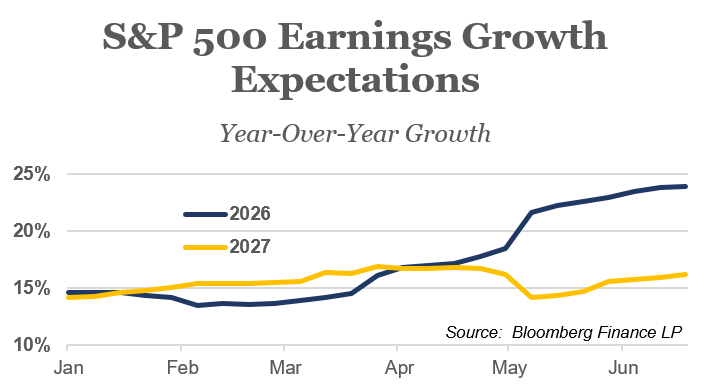
Equity strategists continue to ratchet up their S&P 500 price targets. Earnings forecasts are heading upward as well, both for 2026 and 2027. Prices and earnings moving up in tandem would seem to indicate that fundamentals are indeed driving stocks higher, which is exactly the catalyst that investors want to see fueling a rally. The currently expected 24% earnings growth for 2026 has risen from 14% at the start of the year. Looking forward a year, analysts project that earnings will grow 16% in 2027, versus 14% at the start of the year. While forward year (2027) growth expectations have risen more modestly, the forecasted growth rate is still quite impressive by historical standards. The question now turns to execution, and whether reported results meet expectations. If the last few quarters are any indication, reported results could surpass even lofty expectations. As ever, it’s up to management teams to improvise and adapt to overcome the challenges that arise. Investors are wise to try and identify companies led by exactly those sorts of management teams. Recent market swings offer a reminder than the long-term march upward in stock prices is and has been anything but a straight line. It’s a process of two or three steps forward, followed by a step back. Patient investors will continue to focus on the forward progress, knowing full well that the steps backward – and perhaps associated discomfort – are the price of admission for the gains the stock market has historically provided. As Mark Twain reportedly said, “History doesn’t repeat itself, but it often rhymes.”
