
Market Review
The benchmark S&P 500 index finished the 3rd quarter up 2.0% to follow up a huge 14.9% gain in the 2nd quarter and take the year-to-date gain to 11.8%. If there was a market trend during the last three months, it was mostly sideways, both before and after an earnings-fueled surge in late July and early August. Corporate earnings rose over 53% versus the prior year and topped consensus projections by 26 percentage points (“pp”) during the 2nd quarter, marking one of the best earnings seasons on record. Revenue surprised by slightly more than 3 pp to post growth over 15.5%. Analysts anticipate that earnings grew almost 27% during the 3rd quarter and will expand by almost 33% over the course of the year. The Federal Reserve (“the Fed”) opted to raise their policy rate 0.25% at their September meeting, largely as expected. The vote to modestly tighten the monetary policy stance was unanimous. Fed Chair Warsh termed the move “removing a dose of accommodation” and noted that inflation has been running above the Fed’s 2% target for over five years, though the Fed cannot directly impact every factor contributing to elevated prices.
The Economy
The U.S. economy posted a slightly below-trend 2.2% growth rate during the 2nd quarter, though personal consumption rose by a robust 3.8%. Overall growth was slightly below the Bloomberg contributor average. Per the Federal Reserve Bank of Atlanta’s GDPNow model estimate, 3rd quarter economic growth has risen by a strong 3.7%, which is almost double the rate the economist community anticipates. The Fed’s preferred Core Personal Consumption Expenditures Deflator inflation measure edged up slightly to 3.4% year-over-year in August v. the Central Bank’s stated 2% target, fitting with the narrative on stubbornly elevated inflation. Forecasters anticipate that U.S. G.D.P. will expand by slightly more than 2% during 2026, but there could be potential for an upside surprise if energy prices retreat from current levels. Non-farm payrolls hiring was steady during the 3rd quarter, and jobless claims continue to point to labor market stability, which bodes well for consumer spending. Fed members polled at the June meeting expect that the unemployment rate will remain steady through 2026 at slightly more than 4%, which is quite low by historical standards.
Equity Markets
S&P 500 performance at the index level was middle-of-the-pack relative to individual sectors during the 3rd quarter, trailing roughly half the sectors and topping roughly half. It’s never much of a surprise to see the Tech (+6.8%) topping quarterly sector performance. Spending on artificial intelligence (“A.I.”) infrastructure continues to dominate news flows and drive earnings for Tech and other sectors participating in the buildout. Semiconductor manufacturers continue to post impressive earnings, and the infrastructure owners themselves are starting to demonstrate return on their massive investments. Communication Services (+3.5%) certainly fits as a buildout participant, given infrastructure host Alphabet’s (GOOGL) large weighting and Telecom companies providing the connections between infrastructure providers and users. Industrials (-9.9%) and Materials (-3.2%) companies are vital to the A.I. buildout, and their financial results have benefited, though local pushback on data center construction and power consumption has temporarily pushed out the timeline. Energy posted a 6.0% gain, as oil, natural gas and refined product prices remain elevated. Refining capacity has become a comparable challenge to commodity supply, if not a larger concern. Higher gasoline prices likely crimped discretionary consumer spending and weighed on the Consumer sector, which saw a 4.3% pullback during the quarter. Spending on gasoline currently comprises 2.5% of the average household budget, so higher prices don’t have nearly as big an impact as during prior episodes of higher energy prices, particularly the 1970s. Healthcare (+6.0%) has encountered less policy uncertainty and fewer headwinds after lagging the broader market for an extended period. With longer-term interest rates rising 0.70%-0.80% depending on the maturity range, Financials (-0.5%) can eventually benefit from their ability to earn additional income on new loans. Firms in the sector also benefit from market trading activity and a pickup in initial public offerings and merger and acquisition activity. While higher interest rates can benefit Financial firms, they tend to weigh on Real Estate (-6.3%) firms, as borrowing to finance their portfolios becomes more expensive and their typically generous dividend payouts look comparatively less generous.
Long-Term View
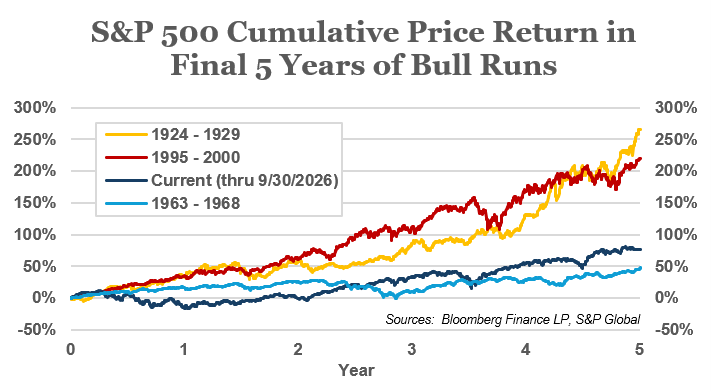
Legendary investor Sir John Templeton is credited with observing that, “Bull markets are born on pessimism, grow on skepticism, mature on optimism and die on euphoria.” Notably, he did not say that bull markets die of old age, as the current version nears its fourth anniversary. Readings on investor sentiment and positioning don’t currently show any hints of a euphoric and over-optimistic state, in spite of the fact that analysts forecast S&P 500 earnings growing almost 19% in 2027. Those forward-year estimates stood at slightly more than 14% as 2026 began and right at 17% as the 3rd quarter began. Given such an outlook, investors could reasonably take an optimistic market view, yet stocks continue to climb a proverbial wall of worry. As ever, the stock market is a forward-looking discounting mechanism. That is to say, prior financial results do provide evidence on a management team’s ability to formulate strategy and execute on it, which might impact how much investors are willing to pay for $1 of earnings, but what matters most for stock prices is expected future earnings. The market can get ahead of itself and extrapolate positive results out into the future or get overly optimistic about those outcomes. High hopes can be dashed when the eventual results don’t match up with expectations. The graphic above offers evidence of two bull markets that ran too far, too fast and eventually gave back what turned out to be outsized gains. By comparison in the same chart, the current bull market seems a bit more measured in its pace, which lends credence to the thought that there’s more upside to come, and solid economic growth certainly helps that narrative. Slow and steady, in relative terms, can win the race.
